 Kristy Fournier
89bf77304c
Kristy Fournier
89bf77304c
Making sure everything in the readme is relevant to the modern version this includes removing references to mp3s (now audio files) and to a seperate web client |
||
|---|---|---|
| Server | ||
| .gitignore | ||
| LICENSE.md | ||
| readme.md | ||
| requirements.txt | ||
| Screenshot_MAIN.png | ||
| wishlist.md | ||

Party Jukebox
This project requires VLC to play sound files
You can use --help on any of the python files to see all the properties that can be changed at runtime
Purpose
The Party Jukebox is a program that allows many people to add music, skip songs, play, and pause from any web device to the same device and playlist.
This was created for a personal use case for parties, and is a simple solution to have a collective playlist for local audio files.
The main advantage compared to doing something similar using Spotify or another streaming service is that you can limit the songs that can be played to your selection. Songs can be chosen, but only from a list.
Basic Setup
Client Setup:
The client is a web application hosted by the flask app running the audio player.
- You can add
?darkmode=(true/false)to the client URL to set the default colour scheme, but this will be overwritten by the user's saved choice if they change it themselves
Server Setup:
Pre-setup: If you want the songs to have art associated with them, it is all hosted on and retrieved from LastFM, and you will need to sign up for a developer app, and put your key in the database generator
The server side consists of 3 files and a directory:
sound/
databaseGenerator.py
webbyBits.py
.env
- Place audio files in the
sound/folder- Supports flac, mp3, and wav files
- Rename
example.envto.envand...- Set the location where your audio files are (Default:
./sound/) - Set the LastFM API key (Optional)
- Change the port of the app (Default:
19054)
- Set the location where your audio files are (Default:
- Run
databaseGenerator.py(Will try to use LastFM API key)- The
databaseGenerator.pywill index all audio files, and save the information tosongDatabase.db - If getting images, this process may take a long time with a large amount of audio files
- The
- Run
webbyBits.py- The port can be customized by editing the
.envfile - You can add an admin password at runtime with
-a Trueas an atribute- NOTE: Do not reuse ANY password for this, it is hashed but 100% unsecure. The best option is just a random string you write down once
- You will be prompted in console for a password to be used
- If this attribute isn't included a random string will be generated as the admin password
- This is intended for protecting certain features for small closed events, not for public security
- The port can be customized by editing the
You can now connect with the client and use the app as normal.
Make sure you have turned down/off any other apps that might make noise or notification sounds
Read on for specific information on each piece of the app.
Details
These are specific details on each section of the app, and how to use them
Server:
sound/contains all audio files by defaultdatabaseGenerator.pyscans through audio files and gets information about themFilename, Title, Artist, Art, Lengthare all saved- If the title and artist are not in the file metadata, it looks for a format of
TITLE_ARTIST.mp3then ofARTIST - TITLE.mp3and otherwise defaults to the file name as the title, and no artist - Art is retrieved from LastFM
- If the title and artist are not in the file metadata, it looks for a format of
- Running with
--mode (update/new)either updates the current database and adds new songs/removes deleted songs, or recreates the entire database (update is default, and is faster in art mode) - Running with
--art (True/False)retrieves art from LastFM or doesn't (True is default)- Can only generate one song / 0.25 seconds, to avoid pinging the LastFM server too much
- Directory to index for music files can be set in the
.envfile
songDatabase.dbstores all the information about each song in a SQLite database with tablessongsandmetawebbyBits.pyimports the database, runs all music playing, and accepts all commands from clients- Searches return matching songs
- Accepts Play-Pause and Skip commands
- Uses port 19054 by default
- Can be changed in the
.envfile
- Can be changed in the
- Running with
--admin (admin password)sets an admin password for moderation on the client- Note: Do not reuse a password, the password is hashed before being sent over the network, but I still wouldn't bet my house on it, no security is guaranteed
- Anyone who knows the admin password can enter it on the client and change the abilities of any non-admin users (for example to limit skipping)
- The total set of features that can be restricted is
- Skip track
- Play-pause toggle
- Add track to queue
- Partymode toggle
- Change volume
- Add duplicate track to queue
- This is a seperate toggle, but is based on the setting "Add track to queue"
- Basically if you can't add at all, you can't add a duplicate either (obviously)
- The total set of features that can be restricted is
- When this argument is left out a random string is generated and printed in console to be the admin password (so keep the console window hidden if you don't want to use it)
Client:
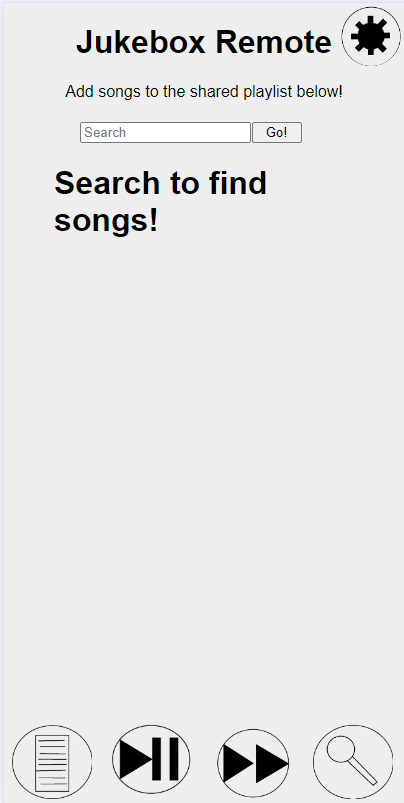
From left to right:
- The playlist button shows the current queue of songs
- The currently playing song is identified, and has the duration listed
- The play-pause button toggles playing
- The skip button goes to the next track
- No "previous" button is a design decision (It's a feature not a bug)
- The search button opens the search screen (pictured)
- The settings button (top right) opens the settings menu
- Dark mode sets a dark mode and stores a cookie to keep you in dark mode after refreshing
- Server IP allows you to change the ip that the site connects to
- Alert time changes how long error/confirmation messages are shown for (Default 2s)
- Party Mode adds new songs to the queue when the queue has only 1 song in it
- Volume controls the VLC volume of the connected server
- Because the volume can be controlled in the client, for best usage set your device volume as high as possible and turn it down using this slider
- QR code to allow others to connect to and use the Remote
- Admin password can be set to restrict actions for general users, or avoid the set restrictions
A quick note on the password feature
The exact process of the password's plaintext scope is as follows
-
On the server, you type in the password on the server in the console, the python script takes that input directly, hashes it, then stores that hash as a variable. The plaintext could be in memory, but it's not accessible in the code after that initial hashing. If you typed your own password, it won't be visible in the console history after it is typed.
-
On the client, you type in the password and press enter. A function reads the value of the password box, saves the hash of that password to a variable, and sends it with all your requests. The plaintext is still stored in the input box, but if you delete it and don't press enter on the box again, the hash will be stored without keeping the plaintext. (I may change this behaviour so this box auto-clears when enter is pressed)
None of this is "secure", but it's better than sending plaintext passwords, which is what I was doing before. Hypothetically somebody who intercepted any packets with the password can't get back the original plaintext, just the hash.
External Credits
- QR Code Generator: JS file found here
- Socket.io: JS file found here
- SHA256 over http: JS file found here
See LICENSE.md for redistribution and editing details.